Encountering Accident: Serendipity in Art-Making
Research · Interviews · Editorial Design · Book Structure · Binding Development
Encountering Accident examines how chance enters the artistic process and how artists negotiate the boundary between control and unpredictability.
Accidents in art may emerge through material behavior, technical error, environmental conditions, unexpected discoveries, or outcomes that were never fully planned. Yet chance does not necessarily imply the absence of authorship. Artists often establish rules, constraints, and experimental conditions that allow unpredictable events to occur. Their role then shifts from controlling every result to observing, selecting, and reorganizing what emerges.
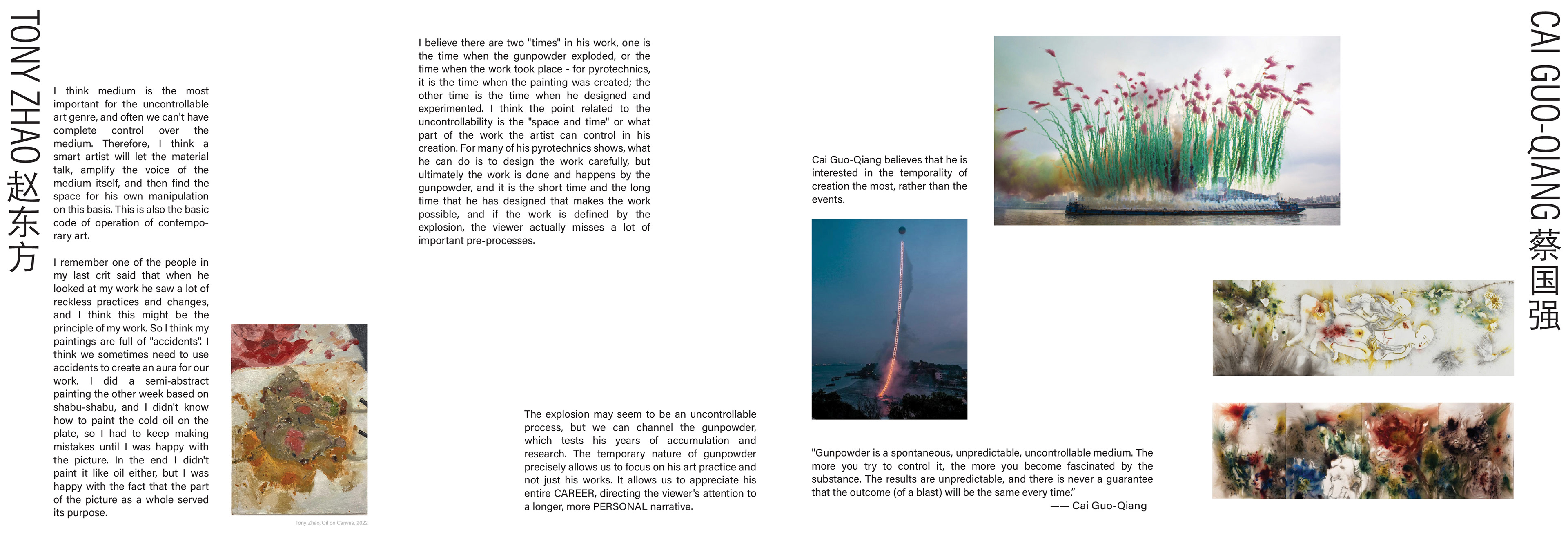
The book consists of two interconnected volumes that can be opened and read simultaneously. The left volume contains conversations with friends and practitioners about how they recognize art produced through chance, how they incorporate uncertainty into their own work, and which artists they associate with these approaches. The right volume presents artists whose practices engage accident, error, material transformation, and controlled experimentation.
The two sequences remain independently readable, but selected pages are designed to align. A practitioner may refer to an artist who appears opposite them; two different works may share a process; or images may create an unexpected formal correspondence.
Rather than presenting accident as a fixed subject, the book turns reading into an encounter. Its structure creates the conditions for connection without determining every connection in advance. In this way, the publication does not simply document accidental art—it performs the idea of controlled serendipity.
The video demonstrates how the two independently bound volumes create shifting visual and conceptual connections as they are turned together and apart